Employment Rights Act: What employers need to know
Keeping up with the Employment Rights Act is no mean feat. Our Group employment law experts have distilled the need-to-know and digested the details below. Download our live tracker and stay in the know on all things ERA related.
How will the Employment Rights Act impact employers?
The Employment Rights Act 2025 is set to reshape how organisations hire, manage, and support their people. Through strengthened employee rights, it creates practical challenges for HR and business leaders:
- Are policies and processes ready to adapt to the changes?
- Do managers understand how the changes will impact them day-to-day?
- Are systems in place to meet stricter enforcement standards?
This is a wide-reaching reform affecting dismissals, sick pay, flexible working, zero-hours contracts, trade unions, bereavement, equality, tips, outsourcing, and compliance. Organisations that act now will reduce future risk and avoid costly mistakes.
Why employers should act now
The Employment Rights Act is not a single reform, it’s a structural shift in employment law. Organisations that plan early will:
- Reduce risk and cost
- Ensure consistent policies and processes
- Prepare managers and HR teams for compliance
- Avoid penalties and reputational damage
Next steps: review policies, update contracts, educate managers, and check systems for zero-hours, flexible working, SSP, and leave entitlements.
Here’s what’s changing…

In force 18 December 2025 👇
Trade Unions
The minimum service levels required in the fields of health, transport, education, fire and rescue and other important services cease to apply.

In force 18 February 2026 👇
Industrial Action Ballots and industrial action dismissal protection
The support threshold of 40% of those entitled to vote voting in favour of industrial action has been removed. The 50% turnout threshold remains until at least August 2026.
Employers must also not dismiss employees because they take protected industrial action. Any dismissal or disciplinary action of striking employees should be escalated for HR/legal review before action is taken.
In force 06 April 2026 👇

Day-one rights to family leave
Paternity leave and parental leave available from day one. Pay will require qualifying service.
Trade Union Recognition
The rules on trade union recognition will be simplified in order to make it easier for trade unions to get recognition.

Sexual harassment and protected disclosures
The definition of a protected disclosure will include a disclosure that sexual harassment has occurred, is occurring or is likely to occur.

Collective redundancy consultation
Compensation for failure to collectively consult will be increased from 90 days to 180 days’ gross pay.

Voluntary gender equality / menopause actions plans
Employers can voluntarily publish action plans on gender equality and menopause support. Larger employers should consider preparing now, as mandatory action plans are expected in 2027.

Holiday records
Employers must keep adequate records of annual leave and holiday pay compliance for 6 years. Payroll, HRIS and holiday recording processes should be checked.

Bereaved Partners’ Paternity Leave
Bereaved fathers and partners to take up to 52 weeks of paternity leave if the mother or primary adopter dies within the first year of the child’s life. This is a non-Make Work Pay measure, which means it’s not been introduced by the Employment Rights Act, but a separate piece of legislation.

Statutory Sick Pay (SSP) Reform
Statutory Sick Pay will be reformed, meaning:
- It starts from day one of absence
- The earnings threshold is removed
- A tapered rate for low earners will be introduced
This will increase early-stage absence costs for organisations that currently rely on the minimum statutory threshold and three-day waiting period.

In force 07 April 2026 👇
Fair Work Agency
Established to deal with enforcement functions previously carried out by HMRC and other government agencies. It will be given a number of powers including compelling individuals to attend meetings, entering premises to inspect documents and bringing claims on behalf of employees.
In force 25 August 2026 👇
Statutory Trade Union Recognition electronic balloting
Statutory balloting for trade unions may be carried out using electronic balloting as opposed to postal or workplace balloting. A new statutory Code of Practice has been published. Recognition/derecognition e-balloting is expected in 2027.

Expected October 2026 👇
Outsourcing and parity of treatment between public sector and private sector workers
Where public services are outsourced to contractors, the contractor’s direct hires cannot be treated less favourably than the public sector workers.
In force 01 October 2026 👇
Time limits for ET claims
The time limit to bring claims in the employment tribunal will increase from three months to six months.
In force 30 October 2026 👇
Duty to prevent harassment
Employers will need to take ‘all reasonable steps’ to prevent harassment (including sexual harassment) in the workplace and by third-parties.
Expanded Trade Union rights and Industrial action detriment protection
New right to a statement of trade union rights and a trade union right of access. Trade union officials and learning representatives are also set to gain rights to facilities and time off.
Employers should ensure managers do not subject workers to detriment for taking industrial action, such as reduced hours, lost opportunities, unfavourable shift allocation or other disadvantage.
Expected at the end of 2026 👇
Tips and gratuities
Employers will need to consult with a trade union or workers’ representatives (or with workers directly) before introducing policies on how tips and gratuities should be allocated (and reviewed at least every three years).

In force 01 January 2027 👇
Unfair dismissal rights after six months
Unfair dismissal rights will start after six months’ service. The original proposal was for this to be a day one right, but the government announced a change in approach on 27 November 2025. The cap on compensatory awards will also be removed.
Expected January 2027 👇
Dismissal and re-engagement (fire and rehire)
New right to a statement of trade union rights and a trade union right of access. Trade union officials and learning representatives are also set to gain rights to facilities and time off.
Employers should ensure managers do not subject workers to detriment for taking industrial action, such as reduced hours, lost opportunities, unfavourable shift allocation or other disadvantage.
Expected 2027 👇

Zero-hours and irregular hours contracts
New duty to offer guaranteed/minimum hours contracts to zero hours workers, those on minimum hours contracts and agency workers based on average hours worked in previous reference period (likely to be 12 weeks). New right to compensation where shifts are cancelled or postponed at short notice or where the employee refuses a shift because the employer has not provided reasonable notice.
Dismissals during pregnancy or family related leave
Stronger protection against dismissal for women who are pregnant and for those who are taking or returning from a period of statutory family leave.
Collective redundancy threshold reform
Employers should prepare for collective consultation triggers to be assessed across the organisation, not only at one workplace.
Bereavement leave
Extended to cover a wider class of family members with whom the leave may be associated.
Flexible working requests
You can only refuse a flexible working request on one or more of the statutory grounds if it is reasonable to do so.

Ban on non-disclosure agreements covering harassment and discrimination at work
Any confidentiality clauses in agreements between an employer and a worker (e.g. a settlement agreement) which prevents a worker from making allegations about harassment or discrimination will be void.
Employment Rights Act 2025 Tracker
The Employment Rights Act 2025 is set to increase the burden on already stretched HR teams – our research anticipates a 230% increase in probation-related tasks alone!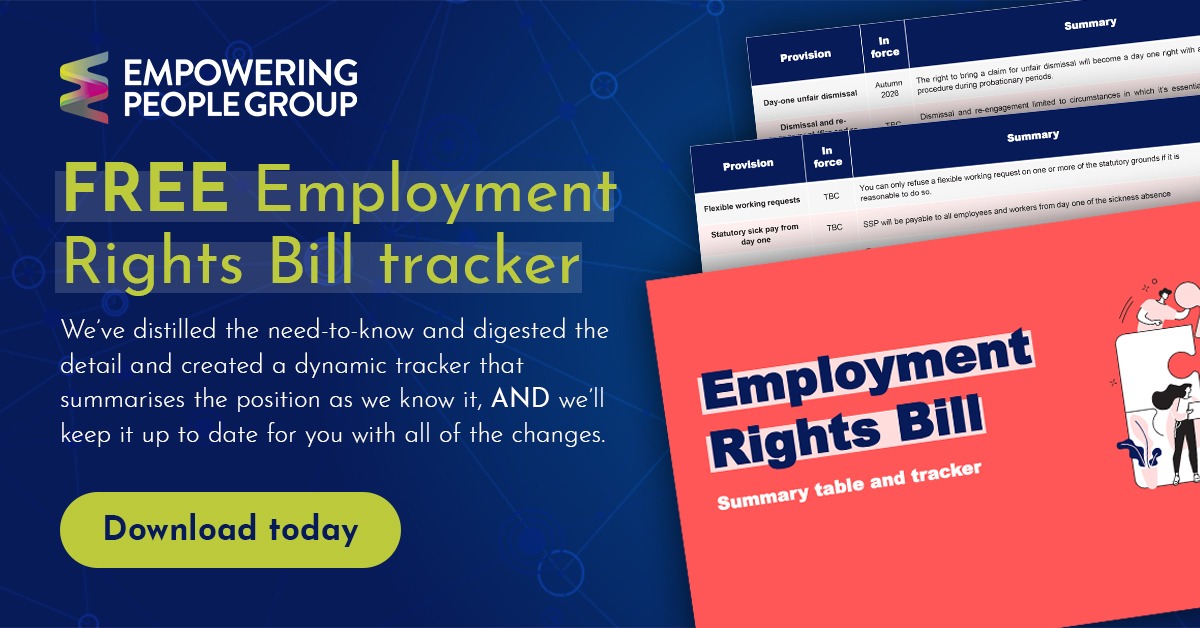
Our handy ERA Summary and Tracker is a great way to stay on top of the Act, implementation dates, and what you’ll need to consider for your contracts, policies and processes. It’ll help you prepare for what’s already confirmed and what’s still evolving. When there are further developments we’ll update the tracker and send you the latest version, without you lifting a finger! Bookmark it, pin it and download it today.
Open consultations…

Make Work Pay: workplace monitoring technologies
Timeline – closes 30 September 2026
The government is seeking views on how to support the fair, transparent and responsible use of workplace monitoring technologies, used to monitor, manage or make decisions relating to workers.
Equal pay and pay discrimination
Timeline – closes 27 October 2026
The government is consulting on comprehensively reforming the pay discrimination framework including addressing gaps and inconsistencies in the framework currently affecting disabled people, those from ethnic minority backgrounds and outsourced workers.
Time off for public duties
Timeline – closes 04 September 2026
The government is seeking views on how the right to time off work for public duties operates in practice, and on proposed changes to the list of public duties eligible for time off under this legislation.
Make Work Pay: holiday pay compliance and enforcement
Timeline – closes 22 September 2026
The Fair Work Agency which was established in April 2026 will be tasked with enforcement functions (e.g. worker’s rights to statutory holiday pay). The government is seeking views on:
- the proposed approach to holiday pay compliance and enforcement
- some of the important design features
- what support and guidance the Fair Work Agency can provide to help support compliance.

Make Work Pay: ending one-sided flexibility – reforms of zero hours and similar contracts
Timeline – closes 25 August 2026
The government is set to introduce significant restrictions on the use of zero-hour contracts in 2027. Ahead of this, the government is seeking views on reforms relating to zero hours and similar contracts, to implement measures in the Employment Rights Act 2025 to end one-sided flexibility.
Make Work Pay: employment rights for unpaid carers and parents of seriously ill children
Timeline – closes 04 September 2026
The government is seeking views on employment rights that are available to people with unpaid caring responsibilities and parents to who have seriously ill children.
Closed consultations…
Make Work Pay: misuse of non-disclosure agreements (NDAs)
Timeline – closed (feedback being analysed).
The government consulted on regulations to prevent the misuse of NDAs in workplace harassment and discrimination cases. The consultation covers when an NDA may still be valid as an “excepted agreement”, who workers may still make disclosures to notwithstanding an NDA, and whether the rules should extend beyond employees and workers to other individuals.
Make Work Pay: Transfer of Undertakings (Protection of Employment) Regulations
Timeline – closed
The government sought views to help inform potential reforms aimed at making TUPE simpler for businesses while strengthening protections for transferring employees.
Make Work Pay: draft code of practice on trade union right of access
Timeline – closed
The government consulted on the draft statutory code of practice for the new framework governing trade union access to workplaces. The code will cover how access requests should be made, how access agreements should be negotiated and implemented, and practical examples of effective engagement. The revised draft code of practice was laid in Parliament on 6 July 2026, alongside secondary legislation setting out the operational and procedural details of the right of access framework.
Make Work Pay: threshold for triggering collective redundancy obligations
Timeline – closed
The government consulted on the new organisation-wide threshold for triggering collective redundancy consultation and notification obligations. Options include a fixed threshold between 250 and 1,000 redundancies, or a tiered approach based on employer size.
Make Work Pay: protection from detriments for taking industrial action
Timeline – closed
The government consulted on the types of detriments that employers should be prohibited from imposing on workers for taking official industrial action.
Make Work Pay: strengthening the law on tipping
Timeline – closed
The government is looking to strengthen laws around tipping. Specifically, they sought views on the new requirements for employers to consult with workers when developing and reviewing tipping policies as well as existing law, code of practice and guidance. A draft updated Code of Practice has been laid before Parliament and is subject to parliamentary approval
Make Work Pay: recognition code of practice and e-balloting unfair practices
Timeline – closed
The government sought views on the proposed changes to the trade union recognition and derecognition processes. As part of this, the government will need to update the code of practice on access and unfair practices.
Make Work Pay: fire and rehire – changes to expenses, benefits, and shift patterns
Timeline – closed
The Employment Rights Act 2025 will introduce a new protection for employees by making a dismissal automatically unfair where this is for the purposes of making changes to the core terms of an employee’s contract. The government consulted on two types of restricted variations in relation to fire and rehire. These are employment expenses and benefits, and shift patterns.
Make Work Pay: improving access to flexible working
Timeline – closed (feedback being analysed).
The Employment Rights Act 2025 is introducing a new process for employers to follow where they are considering rejecting a flexible working request. The government consulted on:
- a proposed new light touch process for employers consulting with employees where a request cannot be immediately agreed
- what training, resources and support can help businesses navigate flexible working requests
- other ways to improve access to flexible working
Make Work Pay: modernising the Agency Work Regulatory Framework
Timeline – closed (feedback being analysed).
As the Employment Rights Act 2025 will bring umbrella companies into the legal framework which governs agencies. Accordingly, the government is now seeking views on:
- how the regulatory framework should be adapted to account for the activities of umbrella companies
- what broader changes should be considered in order to modernise the rules
Consultations TBC…
‘Reasonable steps’ to prevent workplace sexual harassment
Timeline – 2026-2027
A consultation on what will amount to ‘reasonable steps’ to prevent workplace sexual harassment is imminent and is likely to be announced.
Get in touch
Or speak to an HR expert on: 0844 327 2293